You’ve probably said it before: “I know I should be better with money.”
Maybe it’s that late-night moment when you check your bank balance after a weekend out… or when another subscription renews for something you haven’t used in months. You roll your eyes, promise to “get it together next month,” and then somehow, it happens again.
The truth? You’re not bad with money. You’re human.
Managing money isn’t something most of us were actually taught—at least not in a way that connects to real life. Between student loans, rent, rising prices, and the pressure to “live your best life,” it’s no wonder that even smart, hardworking people end up feeling lost when it comes to their finances.
This article isn’t about guilt. It’s about clarity.
Money stress often comes down to a few repeat habits that quietly drain your progress—tiny leaks that, over time, sink your financial confidence. Once you spot them, you can fix them with simple, realistic changes that don’t require becoming a financial expert or cutting all joy from your life.
Over the next few sections, we’ll break down five common money mistakes that many people (yes, even the financially savvy ones) still make:
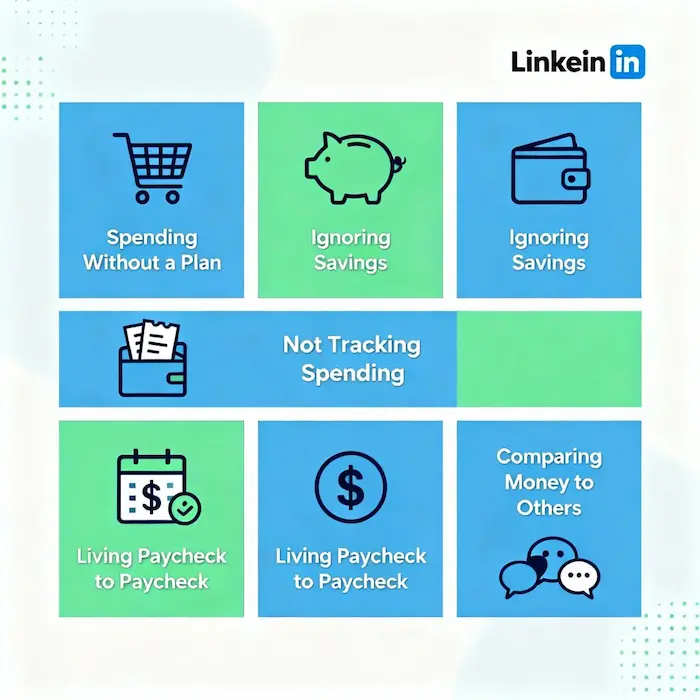
- Spending without a clear plan or awareness of where your money’s going.
- Ignoring savings goals because they feel too far out of reach.
- Failing to track or review how your spending actually adds up.
- Living paycheck to paycheck without a basic emergency cushion.
- Comparing your finances to others and feeling perpetually behind.
You’ll also get practical fixes—simple shifts you can start today to feel more control, less stress, and more alignment between your money and your goals.
You already have what it takes to manage money well. You just need a plan that aligns with your real life—not a perfect one, just an intentional one. So, let’s start by looking at the first common habit that quietly drains most people’s financial potential: spending without a plan.
1. You’re Spending Without a Plan
Let’s be honest—most people don’t have a spending plan. They have “vibes and vibes only.” You see money in your account, you spend until it runs low, and then you pull back, making a mental note to “budget better next time.” But without a plan, your money is running you, not the other way around.
A spending plan isn’t a buzzkill—it’s freedom disguised as structure. It’s how you tell your money what to do instead of always wondering where it went. When you spend with intention, you’re not saying no to fun or flexibility; you’re saying yes to what matters most to you.
Start by getting crystal clear on three questions:
- What are my nonnegotiables? (Rent, bills, debt payments)
- What genuinely adds value to my life? (Gym memberships, weekend hangouts, takeout meals)
- What could I live without if it means less stress next month?
Once you answer those, map your income into simple categories—needs, wants, and growth (savings or debt reduction). You don’t need a fancy spreadsheet. You can even start with a simple notes app or one of those free budgeting templates online. The goal is not to track every penny perfectly—it’s to get awareness and control.
Over time, this habit builds trust between you and your money. You stop feeling like it disappears magically and start feeling capable of making choices that support your goals, not sabotage them.
Money confidence doesn’t come from tracking every expense—it comes from deciding, in advance, what your money’s purpose is. And when you know where it’s going before you spend it, you’re already miles ahead of most people.
2. You’re Ignoring Your Savings (Because It “Feels” Impossible)
Saving money can feel like trying to run a marathon when you’ve barely started jogging. Between bills, social plans, and the occasional impulse purchase, saving often gets pushed to “when things calm down.” But realistically, that perfect month rarely comes. Waiting until you “have enough” to save is one of the biggest traps that keep people stuck.
Here’s the truth: saving isn’t about having extra money, it’s about creating space for your future self. Even a tiny amount—something that feels almost laughable—matters because it builds momentum. It’s not the size of the transfer that changes your life; it’s the habit of making one at all.
If saving has felt impossible, start small. Automate five or ten dollars a week into a separate account you don’t touch. Label the account something meaningful like “future peace” or “travel 2026.” Over time, raising that number gets easier because your brain starts treating saving as a normal, nonnegotiable bill, not an optional chore.
Also, rethink what saving means. It’s not about deprivation—it’s a slow act of empowerment. It gives you choices, breathing room, and confidence when life inevitably throws surprises your way.
You don’t have to become obsessed with numbers overnight. You just need to start treating savings as something you build around, not something you wait for. When you make that shift, saving stops being stressful and starts feeling like self-respect in action.
3. You’re Not Tracking Your Spending at All
Think back to the last time you checked your bank statement. Did you feel confident—or a little shocked by how much quietly added up? Most people don’t realize how small, everyday expenses can chip away at their goals until they start tracking them. Without visibility, your money habits run on autopilot, and autopilot almost never leads to financial progress.
Tracking your spending isn’t about judgment; it’s about awareness. When you know exactly where your money is going, you gain leverage. You stop guessing and start making informed choices that actually line up with what you value most.
Start simple. For one week, jot down every expense—yes, even the one-dollar app purchase or the quick coffee stop. At the end of the week, review your list and highlight patterns. Where were you happy to spend? Where did it feel impulsive or unnecessary? Seeing those trends on paper or screen often sparks that lightbulb moment: “Oh, this is where my money actually goes.”
Then, take the next step—set up an easy system that works for your personality.
- If you’re detail-oriented, use a budgeting app that categorizes automatically.
- If you prefer low effort, enable spending alerts on your bank app.
- If you like journaling, create a weekly “money check-in” where you total up categories and note how you felt spending in each.
This isn’t about micromanaging your life—it’s about reconnecting with your choices. Tracking gives you space to pause before that extra click or swipe, helping you decide whether something truly adds value or just fills a momentary urge.
Over time, this awareness builds financial mindfulness. You start catching leaks early, appreciating intentional purchases, and realizing that control feels better than avoidance ever could. Money tracking becomes less about spreadsheets and more about self-knowledge—the best investment you’ll ever make.
4. You’re Living Paycheck to Paycheck (Without a Safety Net)
Living paycheck to paycheck feels like being stuck on a treadmill that never slows down. Money comes in, bills go out, and by the time you catch your breath, it’s payday again. You’re working hard, but one unexpected expense—like a car repair or doctor visit—can send everything into chaos. The problem isn’t just the lack of savings; it’s the lack of a buffer between you and financial stress.
That’s where a safety net comes in. Think of it like a financial pause button—a small cushion that keeps you steady when life throws surprises your way. You don’t need to save thousands right away. Your first goal is tiny but powerful: one paycheck’s worth (or even a few hundred dollars) set aside, separate from your spending account.
Here’s a simple, realistic way to start:
- Open a separate “safety net” account—no debit card, no easy access.
- Automate a small transfer every payday (even ten or twenty dollars).
- Treat it like a bill you pay yourself first, not something left over if you’re lucky.
This habit builds emotional relief as much as financial stability. Bit by bit, you realize that you’re not living on edge waiting for the next crisis. The fear of “what if something goes wrong?” starts to fade because you’ve already prepared for it.
As that fund grows, aim for one month of basic living expenses—then slowly stretch to three. Even if it takes a year or two, it’s worth the patience. Every deposit is a small act of freedom. It buys peace of mind and the ability to make calmer, wiser choices instead of reacting out of panic.
Living paycheck to paycheck isn’t a moral failure—it’s a starting point. The moment you decide to build your safety net, you stop merely surviving and start creating stability that supports your future self.
5. You’re Comparing Your Money Situation to Everyone Else’s
Few things mess with your financial peace like comparison does. You scroll through social media, see people your age traveling, buying homes, or posting about their side hustles, and suddenly your own progress feels embarrassingly small. But here’s the truth: comparing your financial timeline to anyone else’s is like comparing a novel to a single Instagram caption—you’re only seeing the highlights, not the full story.
Everyone’s money situation runs on different variables—income, debt, family help, health, geography, timing, even luck. What looks like financial success on the outside might include unseen struggles or sacrifices on the inside. The problem is, constant comparison doesn’t motivate you; it drains you. It can push you into spending out of insecurity rather than intention, chasing validation instead of stability.
The antidote is refocusing on your own lane. Start tracking your markers of progress. Did you pay down a small piece of debt this month? Start an emergency fund? Say no to a purchase that used to be automatic? Those are wins worth celebrating. They might not be flashy, but they’re the kind of steps that quietly transform your future over time.
You can also curate what you see. If certain online spaces trigger comparison, mute or unfollow them for a while. Instead, fill your feed and your conversations with stories that inspire growth, not guilt. Surround yourself with people who talk about goals, habits, and learning—not just purchases.
Remember, money isn’t a race; it’s a relationship. And it’s uniquely yours to build. The more you align your financial progress with your own values—not anyone else’s timeline—the more peace and confidence you’ll feel day to day.
It’s okay to admire someone else’s success; just don’t assume it defines your worth. Your path is valid, your progress is real, and right now, you’re exactly where your financial story is supposed to be.
Wrap Up: You’ve Got This Money Stuff
Here’s the good news: fixing your money habits doesn’t require perfection—it just requires awareness and a bit of consistency. Every small choice you make toward clarity, saving, or planning compounds over time into confidence. You don’t need to become a budgeting expert or restrict yourself into misery. You just need to keep showing up for your financial well-being the same way you do for everything else that matters.
Money is one of the few areas in life where progress happens quietly. You won’t always see big wins right away—but you’ll feel the difference. Less anxiety when you check your balance. More confidence when those unexpected bills come up. That sense of calm when you realize you have a little cushion or a plan instead of panic. That’s how you know the work is paying off.
So if any of these five mistakes hit home, take it as a sign of awareness—not failure. Awareness is the first step toward power. You can always reset, redirect, and rebuild better habits starting today. Pick one fix from this article, put it into action this week, and give yourself credit for every small win along the way.
Remember, the goal isn’t just financial security—it’s financial peace. And peace comes from knowing you’re making intentional decisions with what you have. You don’t need to have it all figured out to start. You just need to start.